Leaf Wrapped Snack
Mieng Kham is a great, easy to make (albeit a bit time-consuming) appetizer or snack. It’s fun to eat and healthy too! This is an excellent dish to serve at a party.
Directions
- Dry roast the coconut in a wok on medium high, stirring constantly to avoid burning. Cook until the coconut is medium brown, about 5 minutes. Set aside the amount used for the sauce, and put the rest into a serving bowl.
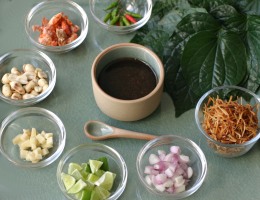
- Cut up all the ingredients which are not to be put into the sauce into small 1/4″ pieces. Arrange in small bowls, or in piles on a plate.
- Now, for the sauce… In a stone mortar & pestle, pound together the shallots and galangal until fine. Set aside.
- In a small sauce pan, add the water, fish sauce, palm sugar & shallot/galangal mixture.
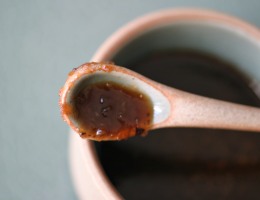
- Boil over medium heat to reduce the sauce to the thickness shown in the picture below. You’re going to boil off about 1/2 the liquid. Make sure to keep stirring every now and then.
- Add the roasted coconut, remove from heat, and put into a small bowl.
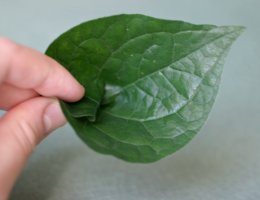
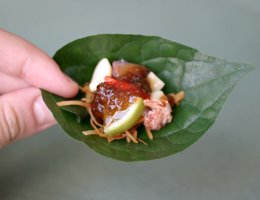
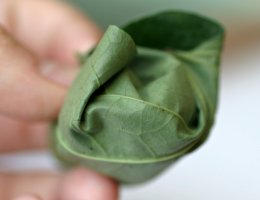
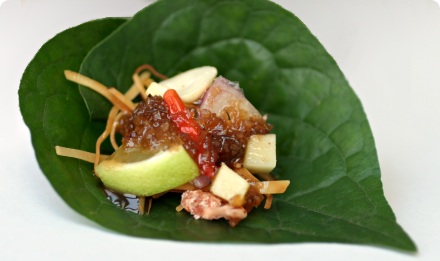
- To eat… Take a leaf and fold the bottom to make a pouch (see large pic above). Put a large pinch of roasted coconut in first, then follow with a piece or two of everything else from the serving bowls: shallots, lime, ginger, peanuts, shrimp and a chili if desired. There is no ‘proper’ order to put them in. Then, add a bit of sauce on top, roll the leaf to make a packet, and eat in one bite. Eating Mieng Kam is like a taste explosion.
Note:
In Thailand, Mieng Kham is usually served with betel leaves. These may be next to impossible to find outside of Asia. Instead, we recommend lettuce, chinese broccoli, or a similar broad leaf vegetable. You can find pre-shredded coconut in the baking section of the grocery store, if you don't feel like shredding fresh coconut. But make sure you buy it unsweetened.
Ingredients: What You'll Need
- 1/4 cup dried shrimp
- 1/4 cup dry roasted peanuts
- 20-30 betel leaves, lettuce leaves, or chinese broccoli
- 1 chopped lime (with skin - the thinner the skin, the better)
- 1/4 cup chopped shallots
- 20 chopped small thai chilies
- 1/2 cup grated toasted coconut
- 1/4 cup chopped raw ginger
...And The Sauce:
- 1/2 tablespoon finely sliced galangal
- 1/8 cup chopped shallots
- 1 cup water
- 1 cup palm sugar
- 1 tablespoon fish sauce
- 1/4 cup grated toasted coconut
Loading...
(13 votes, average: 4.46 out of 5)
hi! i had something like this at the chatuchak market in thailand. just wondering how it is made….i had leaves with something sweet and tangy in a skewer….is it mieng kahm?
It could be mieng kam… Do you remember if the insides had crunchy bits like toasted coconut and peanuts? The leaf was fresh, and not grilled, right? I’m thinking what you might have had is pre-wrapped Mieng-Kam-on-a-stick, ‘to go’ style.
I can’t think of anything else offhand which would have a sweet and tangy inside wrapped in a fresh leaf. So I’m guessing this is probably what you had.
The leaf is atually called shaploo/chaploo in Thai or lalot in Vietnamese.
It is a vine and the heart shapped leaves are used for Miang Kam. In Vietnam the leaf is wrapped around ground meat and spices and grilled.
I have one plant, but usually just buy the leaves at the Laos/Thai market in Richmond, CA.
A good way to toast the coconut pieces is in the toaster oven, but watch carefully!
You can fold the little bundles and pin with a thin bamboo spike that is about 1 1/2″ long or less, but be careful hey are sharp. Works great to hold in the ginger, chiles, coconut, lime, garlic, etc. YUM – love these.
There are many variations on this type of snack that is very popular in Isaan.
I love this, but never make them in the US because I can’t find the leaves. Everytime I go home to Malaysia, I always have this in my favorite Thai restaurant.
Hey Cee,
I made these but modified the recipe a little. I omitted galangal since I hardly ever cook with it, and added tamarind and dried chilies to the sauce. I subbed Meyer lemons for the limes since they’re thin-skinned and b/c my uncle has a tree.
Still yummy.
Did you actually use betel leaves (from the vine?) or wild betel leaves (from the short shrubby plant?). I used wild betel leaves, which VNese call la lot, and I was a bit disappointed that eating them raw didn’t have the same fragrance or aroma as cooking them does.
i just stumbled across your website and it’s just beautiful! so helpful, and very elegantly designed! this looks great, and i will definitely be browsing your archives for more!
Wandering Chopsticks -
I use a leaf which grows on the ground. It’s kind of a wandering plant, almost like a vine, but doesn’t grow up walls. It really gets around though. It doesn’t grow so tall, maybe only one foot?
This one tastes kind of bland but has a nice subtle flavor. They don’t have much flavor cooked either. I hope that helps you figure out what I’m using
/Cee
so now i know what it’s called!
its a really wonderful snack…!!!!
gosh i really miss my times spent in thailand!
haha, and i always get abit greedy and pack in loads of ingredients!
[...] used for Miang Kam. In Vietnam the leaf is wrapped around ground meat and spices and grilled. …http://www.realthairecipes.com/recipes/leaf-wrapped-snack/The Knot – Homemade Bouquets: Calla Lily SheafInstead of ribbon, this contemporary calla lily [...]
I have found a related page! Visit http://newfileengine.com/
I find it very useful when you try to find something quickly!
We love Mian Kam in Nebrasks. My wife is Thai and found the perfect leaf the Nasturtiums flower that grows in most areas in warm weather and the flowers are a bonus for the bundle. They both have a spicy taste. Adding flower to the spicy bundle in the leaves. The plant needs full sun and and the leaves get about 3-4 inches.