Panang Curry

Panang Curry

Panang Curry (sometimes written Penang Curry) is a dry curry which is fried in coconut milk, and not boiled. Panang uses the thicker part of the milk, or the cream only. It’s typically made with beef, although you can make it with pork or chicken as well. It is usually just meat, and is seasoned with sliced lime leaves and sometimes a few leaves of Thai basil.

Directions

  1. The first step is to make the curry paste. Start by soaking the chilies in water until they’re soft. This could take up to a half hour. When they’re soft, cut them open to remove the guts & seeds.
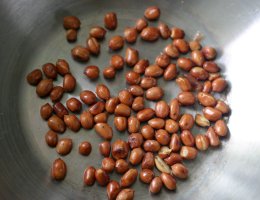
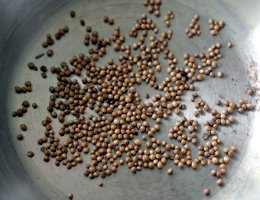
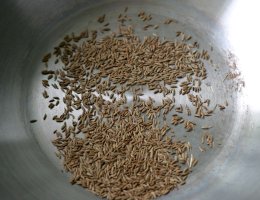
  2. Toast the cumin seeds, cilantro seeds and peanuts separately in a pan over medium heat. Roast each until fragrant, about 3-5 minutes.
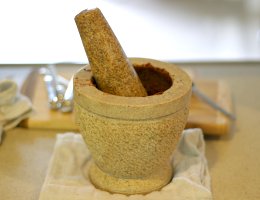
  3. Grind up the seeds together in a stone mortar & pestle until powdered. Remove and set aside.
  4. Add your chilies with the salt to the stone mortar & pestle and pound until a paste. This will take awhile — the skins are difficult to mash. Be patient.
  5. When your chilies are a uniform paste, add the lemongrass. Pound until a paste. Then add the galangal and coriander roots, and again, smash until paste.
  6. Add the peanuts, shallots, garlic and your powdered cumin & cilantro seeds. Mash until paste. Add the shrimp paste and pound to mix well. Set aside.
  7. Cut your meat cross-grain into thin slices (about 1.5″ (4cm) long x 1/2″ (1.25cm) tall x 1/8″ (.25cm) thick).
  8. Now, on to frying your curry! Heat up your pan first on medium-high heat, then add 1/2 cup of the coconut cream. It should sizzle right away and boil. Add all the paste and mix well.
  9. Fry the paste. You want to keep the paste dry, but not too dry that it sticks and burns. Keep adding a little bit of coconut milk when it gets too dry, maybe about 1/4 cup every minute or two. Keep stirring so it doesn’t burn.
  10. Keep adding coconut cream about 1/4 cup at a time, every minute or two. You should start to see a lot of oil coming to the top of the curry. This is normal and a sign that you’re doing it right!
  11. Your paste should start to smell really good after 4-5 minutes. You’ll start to see a lot of oil rising to the top, especially where it’s bubbling. When it does, add your meat.
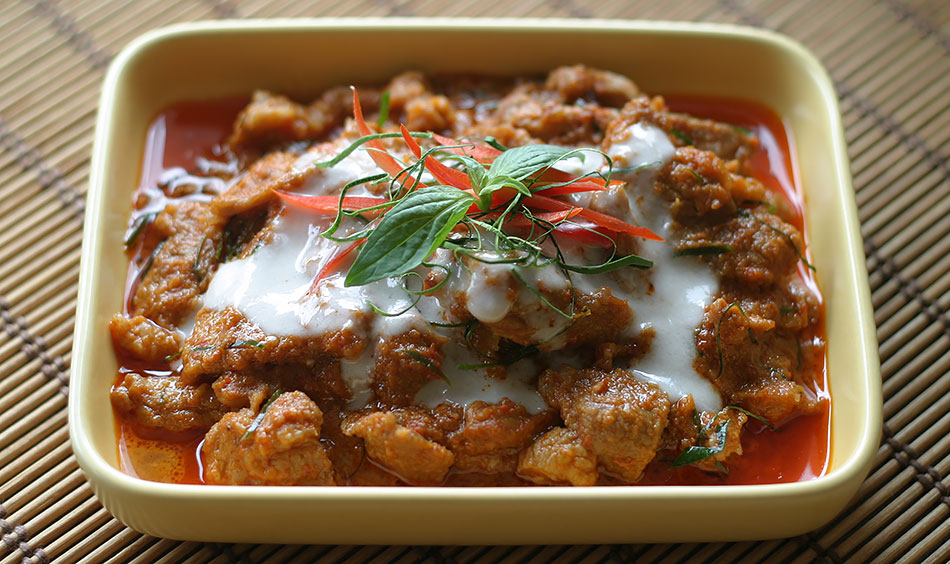
  12. Cook the meat until cooked, add the lime leaves and palm sugar, then keep going about 3-5 minutes so the meat is soft. The consistency of the curry should be similar to the photo. If it’s too dry, add a bit more of the coconut milk. Remove and serve.
  13. Feel free to garnish with shredded lime leaves and a few leaves of Thai basil. Some fancy restaurants serve it like shown with a bit of thickened coconut cream (thickened with a bit of tapioca flour) which you’re welcome to do too!

Note:

Panang Curry should be dry and thick like this, and not soupy like red or green curries. While Panang is usually made with meat, some restaurants serve Panang with shrimp. It's up to you!

If you'd like your Panang curry to be a bit hotter, try adding some :small dried chilies: in with your paste.

Slicing the meat thin like this allows the meat to get soft and absorb the flavor quicker.

1 Star2 Stars3 Stars4 Stars5 Stars (78 votes, average: 3.58 out of 5)
Loading ... Loading ...

Bookmark this article!

DiggDel.icio.usBlogLinesTechnoratiDiigoStumbleUponma.gnolia

RawsugarFacebookFurlGoogleRedditSquidooYahoo

Ingredients: What You'll Need

  • 2 cups homemade (or 1 can) :coconut milk:
  • 1 tablespoon shredded :lime leaves:
  • 1/2 teaspoon :palm sugar:
  • 2 cups sliced beef or pork
  • 2 tablespoons :fish sauce:

The Curry Paste:

  • 1/3 cup :big dried chilies:, soaked until soft with seeds removed
  • 1 teaspoon :salt:
  • 2 teaspoons :galangal:, cut into matchsticks
  • 2 tablespoons :lemongrass:, cut into thin rounds
  • 1 tablespoon :cilantro root:
  • 1 teaspoon toasted :cilantro seeds:
  • 1 teaspoon toasted cumin seeds
  • 2 tablespoons :garlic:
  • 2 tablespoons :shallots:
  • 1 tablespoon roasted :peanuts:
  • 1 teaspoon :shrimp paste:

Roast

Roast the peanuts until browned

Roast

Roast the coriander seeds until fragrant

Roast

Roast the cumin seeds until fragrant

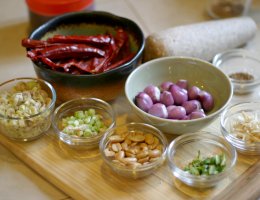
Prepare

Prepare your ingredients for the paste

Pound

Pound all the ingredients together

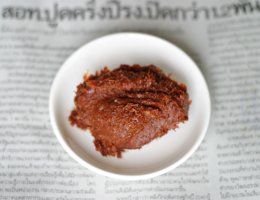
The Paste

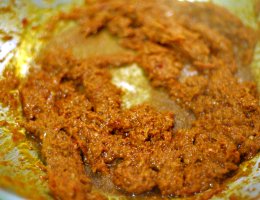
The finished paste should look like this

Cut

Cut your meat into thin slices

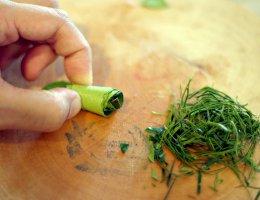
Cut

Roll and cut the lime leaves into thin slices

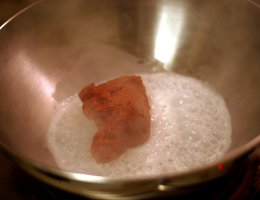
Fry

Fry the paste in some of the coconut cream

Fry

Fry until you see oil and it smells good

Add the Meat

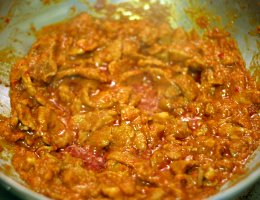
Add the meat and cook for a few minutes

Add

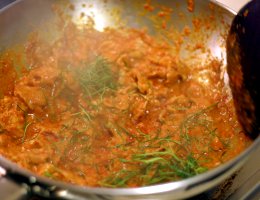
Add the lime leaves and mix well

40 Responses to Panang Curry

  1. on 07 Sep 2007 at 4:51 am Maddy said:

    The curry paste sounds yummy – how would it go as a vego version made with extra salt to substitute for the shrimp paste?
    I presume this would be too strong a flavour for tofu, but how about with potatoes, eggplant and spinach?

  2. on 07 Sep 2007 at 10:54 am cee said:

    Maddy -
    Here’s what I would recommend if you want to make a vegetarian version:

    Leave out the shrimp paste and add another 1/2 tea of salt when you make the curry paste. I’d use tofu or mock duck meat from the Chinese grocery. If using tofu, cut into 1/2″ thick x 1″ x 1″ cubes and deep fry first. Then cook as you would meat. If you get the mock duck, just throw it in — don’t pre-fry. I wouldn’t recommend adding any veggies. Try just tofu or mock duck first, so you can get a good feel of the taste of the curry paste. The paste is the king of this dish.

    Let me know how it turns out, and good luck!

  3. on 11 Sep 2007 at 8:42 pm Riya said:

    … not very fond of coconut milk.
    but i will give it a go only with beef.

    : )

  4. on 15 Sep 2007 at 9:25 am angi said:

    hi! our mutual friend cosmo just pointed me to this site — this is such a great collection of recipes! thank you! and the photography on here is beautiful… i am literally starving after just looking at a couple of these dishes. :)

  5. on 17 Sep 2007 at 8:34 am Christine said:

    Hi – I found this sight and just love it! I also cannot wait to try this recipe! But is it possible to use a premade curry, insead of preparing it from scratch? If so, is there a specific one you would recommend?

  6. on 25 Sep 2007 at 4:40 pm cee said:

    Angi — I’m glad you like the site! Give Cosmo a big hug for me if you’re nearby will ya?

    Christine — It is possible to use pre-made curry paste instead of homemade. I haven’t taste tested the difference between the two big brands (mae sri and mae ploy) for Penang. I generally like mae ploy (the plastic tub) better. If you’re using this style of paste, it might help to freshen it up a bit with some crushed garlic. I don’t think they add the peanuts either, so you may want to add that when you fry it.

  7. on 25 Sep 2007 at 10:59 pm Doug Irvine said:

    Just found this site and have bookmarked it to my section of Thai recipes. I have a lot of Thai recipes and do my version of Pad Thai at least once or twice a week. I have been cooking Asian since 1952, and do Chinese, all areas and some Viet, Indonesian and India. I also cook Mexican, and I do all the cooking while my wife whom I met in 1947, does all the baking. We have been working together like that for all these years

  8. on 22 Nov 2007 at 8:08 am Peekay said:

    Great site. Clean and well done. I love the slide show, very helpful. I stumbled upon this site while trying to find out more about Panang Curry. I bought a can of this from my local Asian supermarket and it turned out great. I think, I’ll try making it fresh thanks to you.

  9. on 06 Jan 2008 at 8:59 am Melanie said:

    Hey great website. I’m attempting to make Khang Panang for my husband. I can only find the panang curry recipe. Is this recipe what I need to use. I am confused!

  10. on 06 Jan 2008 at 9:45 am cee said:

    Hi Melanie -
    Kang (pronounced more like “gang” in English) is “curry” in Thai. Well, it’s any sort of soupy mixture, including soups. So, Kang Panang is Panang Curry — this recipe. Good luck, and let us know how it turns out!

  11. on 16 Jan 2008 at 4:48 am Shannon said:

    Hi! What a great recipe, thanks so much for posting it! I grew up on Thai food, and Panang is one of my favorites. The other day I had the most amazing Panang at a local restaurant – instead of sliced beef it seemed like they used a roast, like a chuck roast or beef shoulder. It was so good – the meat was so tender and flavorful. Do you have any idea how to go about preparing this dish with a chuck instead of sliced beef? I would love to make it at home!

  12. on 16 Jan 2008 at 10:41 am Ric said:

    Thanks for this great recipe – have been looking for this a long time. Excellent!

  13. on 19 Feb 2008 at 6:49 pm ray said:

    This looks like a great recipe- I’ve been searching for one. Thanks. Just a couple questions, though. Most, if not all, panang curry recipes I’ve seen use something like 1/8-1/4 cup fish sauce after frying the paste. Think that would be a good idea? Also, Thai basil- should I include some as well?

  14. on 19 Feb 2008 at 10:04 pm cee said:

    Hi Ray,
    Good catch – we forgot to put the fish sauce in. Oops! :)
    I added 2 tablespoons – start with that, you may need to add another one to taste. It’s already salty from the salt+shrimp paste in the curry paste, so it’s up to you.

    And yes, feel free to add a bit of Thai basil at the end if you wish. The important garnish to not forget is the shredded lime leaves.

    Thanks for the heads up, and let me know how it turns out.

  15. on 03 Mar 2008 at 2:49 pm Serene said:

    I just made this for lunch! It’s my all-time favourite thai curry. must-have whenever in thailand. Now i can make it at home! didn’t make the paste though, i bought instant ones off the shelf.

    Thanks for sharing your recipe!

  16. on 08 Mar 2008 at 6:42 am liz said:

    I am trying to teach myself to cook thai food. I have had a lot of success with all things NOT curry, but I’ve made about 10 unedible curry dishes until I came to this panang curry. I made it with beef and it was terrific! I also made the curry paste from scratch. Before now, I did not have a mortor and pestle either though. I think it did make a big difference to the taste to make the fresh paste. THANK YOU so much. My husband thanks you also. -Elizabeth

  17. on 22 Mar 2008 at 1:40 am Anjy said:

    Hi Cee,
    Just came across your website today and love it. I spend a few months in Thailand a while ago and just loved the food. I look forward to enjoying many delicious home made Thai curry’s very soon. Thanks

  18. on 02 Apr 2008 at 8:53 pm Danmot said:

    Hi, i tried this recipe a while ago and it worked really well.
    I’m having some friends around in a few weeks and plan to cook this as a main course, any ideas what would go well as a starter?

  19. on 28 Apr 2008 at 5:03 pm cee said:

    Hi Danmot,
    Thais don’t eat the same way that Westerners eat (starter, main, dessert, etc). All the dishes are just out on the table and everyone eats from the center. See the “How to Eat Like a Thai” article on our site.

    That aside, if you wish to eat Western Style, I recommend perhaps one dish from the “Snacks and Street Food” section of the site, and perhaps a “Yum Thai Salad” too. And don’t forget the rice!

    Enjoy!

  20. on 18 Jul 2008 at 6:49 pm Dan said:

    Hi, Love the site. Just a quick silly question though, for the panang recipe, how many people does this make for?

    Thanks

    Dan

  21. on 29 Aug 2008 at 2:51 pm My said:

    Hi. Lovely site with all the details. I want to try this curry and other dishes, but where I live in Indonesia I can only get coriander seeds, not the leaves and roots. Will I still be able to cook authentic Thai? Sometimes I cheat with the ubiquitous lemon basil, but I know its not the same. Can I substitute something or just leave out the coriander? Thanks a bunch.

  22. on 29 Aug 2008 at 2:58 pm cee said:

    Dan -
    This recipe will feed about 2-4 people with rice. I recommend cooking another dish or two to balance it, as curries are quite heavy. Perhaps a tom yum and a fried veggie dish.

    My -
    Indonesia doesn’t have coriander/cilantro? That can’t be right. Perhaps you are confusing the plant? It’s called ‘Ketumbar’ in Indonesian, if that helps.

    http://id.wikipedia.org/wiki/Ketumbar

    It’s got to be common there – there hasn’t been a country in Asia I’ve been to yet which didn’t have it. Especially SE Asia.

    Good luck!

  23. on 24 Sep 2008 at 4:24 am Alice said:

    Hi, I hope you were looking for the number seven, didn’t quite understand what that meant. OK, on to the Panang Curry.

    I’ve been successful in growing lemon grass (lots of it) and Thai basil. Now I need to know how to use it for making the Panang. I live not to far from the large Asian Market, Super H, but it’s mostly Korean and lately I’ve not been able to find the small cans of curry paste. I picked a small jar of Instant Red Curry paste so I’m going to see how it works out. Also, I picked up a 1.1 lbs. plastic container of Red Pepper Paste (Taeyahgcho Gochujang) it’s Korean and I probably won’t want that in my curry. What are your thoughts? I live in an Atlanta suburb, there’s lots of Vietnamese and Koreans but apparently not many Thais. I’ve run all over town trying to find panang curry paste with no success.

    Can’t find Kifir lime leaves, is ordering them on-line a good option or do they come all dried out? Maybe I should try to grow that too.

    I love your site but even more….I love Thai food.

    Thanks for a wonderful web-site.

    Alice

  24. on 24 Sep 2008 at 4:28 am Alice said:

    A correction and clarification: it’s the panang curry paste I can’t find. Also know that should have been “too” far from a large Asain Market.
    Didn’t want to sound like a dummy.

  25. on 24 Sep 2008 at 4:29 am Alice said:

    A correction and clarification: it’s the panang curry paste I can’t find. Also know that should have been “too” far from a large Asian Market.
    Didn’t want to sound like a dummy.

  26. on 24 Feb 2009 at 10:55 pm Michael H said:

    This dish looks so beautiful. I’ve been experimenting with curry recently, and I’m going to try to replicate this. I live in Chicago in an area with a high concentration of Thai restaraunts (Lincoln Square), and there is even a little Thai grocery store just a block or so from my house. Maybe in a year or two my knowlege of Thai cooking will be through the rough.

    My only problem will be forcing myself to cook instead of trying out all the great Thai places around me…

  27. on 23 Mar 2009 at 11:38 pm amy said:

    hey cait. i’m planning on making the panang curry your mom brought back. do i need to add fish sauce and palm sugar or is it already incorporated? your site looks DELICIOUS, will definitely be back for more. hope all is well with you. miss ya!
    amy

  28. on 24 Mar 2009 at 1:34 am cee said:

    Amy-
    The curry paste does not have the fish sauce or palm sugar – just the ingredients listed inside the “curry paste” box. So start with step #7 since you already have the curry paste made for you. And in the ingredients section, ignore the “curry paste” box and just get the lime leaves, fish sauce, coconut milk, etc. If you’re not going to make it within the next two weeks, keep the paste in the freezer. Enjoy!

  29. on 27 Mar 2009 at 11:55 pm Anna said:

    This recipe looks fantastic! I would like to braise beef short ribs for this recipe. I’m wondering what I might use for the braising liquid? Would the homemade curry paste hold up to braising? If yes, should I use the coconut milk, not cream, with the curry, braise the meat and use the braising liquid as a base for the dish? Sorry so many questions, but I’ve been researching Thai recipes all day and I’m feeling a bit overwhelmed! Thanks for your help. Anna

  30. on 23 Apr 2009 at 9:58 pm Shel said:

    This looks so right! Plan to make a big batch of the paste and freeze some. One question — what kind of beef do you use? Top round seems to get tough even when thinly sliced. Chuck would take a long time to soften up, wouldn’t it?

  31. on 23 Jun 2009 at 10:27 am Dave said:

    Hi Cee,
    Great site, great recipe description, great photos!
    I just tried to make the recipe, but with fresh red chiles instead of dried. In the end, the paste ended a bit weak, and didn’t allow for too much coconut milk (without tasting bland)so it was really thick. Does using dry/fresh chiles make a big difference?? How many dried chiles do you use (hard to measure 1/3 c) How many fresh?? thanks!

  32. on 21 Jul 2009 at 11:33 pm Steve said:

    How many does this serve?>!

  33. on 01 Nov 2009 at 9:00 am Kruti said:

    Your recipe looks great, I am planning to make it for my fiancee’s bday dinner, we both love panang curry. What’s the serving size of the sauce?…we tend to like extra. I’m excited to try it out!

  34. on 07 Dec 2009 at 3:32 am Pushpa said:

    tried to make tom kha soup but when I added coconut milk it got separated. what did I do wrong?

  35. on 13 Dec 2009 at 7:48 am Inala said:

    I’ve fallen in love with Thai food all of a sudden and made red curry for the first time the other day and it turned out great. However, panang curry is my favorite! but I’ve run into a problem… I can’t find lime leaves anywhere! Can you recommend a substitute or somewhere I can find lime leaves?

  36. on 07 Jan 2010 at 4:55 am Ali said:

    Anna–

    Sorry, this response is just about a year too late, but I hope you still look at this page from time to time. I recently had amazing panang braised short ribs at Nan restaurant in Atlanta and have been itching to reconstruct the dish ever since. Tomorrow is the day! I’ve been working with coconut milk a lot lately, particularly in my slow cooker, and I’ve found that I have no problems with separation as long as I don’t let it get hotter than a gentle simmer. Also, just for convenience’s sake, this time I’m going to use a storebought spice paste–I have a tin each of Maesri and Mae Ploy’s version, and I’ll just do a taste test to choose.

    My plan is to first pan sear the short ribs (salted) in chili-lemongrass oil that I’ll whip up. Then, in the same pan, I’ll fry the spice paste in the coconut milk as described in this recipe, adding the fish sauce, lime leaves, and palm sugar once it’s cooled. I will add the curry to the ribs and then throw it all in the slow cooker, set on low. I think this will turn out just right. Since I love fish sauce, I’ll add another dash just before I take the meat out of the cooker. And I’ll squeeze some lime juice over them once they’re off the heat, just to give them a cool, sour edge, and serve them with thai basil, plain white rice, flatbreads (I buy frozen parathas at the South Asian grocer–they’re pretty much exactly the same as roti canai), and chilled ahjaad–an absolutely delightful and simple cucmber salad.

    As far as coconut is concerned, coconut milk is about twice as dilute as cream. Since my curry is going to have tons of time to reduce (leaving the lid off the cooker for the last hour of cooking is unkosher, but it works for me) I’m not going to mess with cream.

    Alice–

    Try the Buford Farmers Market right at the intersection of 85 N and 285. They have everything!

    Good luck to everyone!

  37. on 08 Jan 2010 at 9:05 am Ali said:

    I just finished my Panang Braised Short Ribs and they were *fabulous*. I made them exactly as I described above, using the Maesri brand curry paste–I found its flavor to be far superior to Mae Ploy’s. The only thing I hadn’t anticipated in making this dish was that the fat from the beef would dissolve and form a thick layer over the curry as it cooked (duh). I simply removed the meat with tongs when it was ready, and then passed the gavy through a fat separator. I also added a little more coconut milk to the curry to soften it–the flavor was a little too concentrated right out of the pot. Then I poured it back over the meat, warmed it all in the oven until the rest of the meal was ready, and voila! Homecooked and better than any restaurant.

  38. on 02 Feb 2010 at 12:24 pm Gordon said:

    Wonderful recipe!

    I have traveled several times to the border of Thailand and Burma, and have eaten the most amazing panang at a restaurant called Aiya’s in Mae Sot. No panang has ever compared to the quality of ingredients and the taste of the freshly made panang from Aiya’s.

    Every time I visit a Thai restaurant in the United States, from Hawaii to New York (I live in Los Angeles), my heart says, “Try the panang,” while my mind says, “try something else.” I inevitably try the panang with the faint hope that someone will make it fresh and as delicious as Aiya’s. I am always disappointed however, as most make their curry from pre-made paste from a tub – even in Thai Town!

    Having taken such a long time already, I’ll get to my point. Your recipe hit it almost dead on. The taste, texture, aroma, all come so close to Aiya’s. I’ve now made your recipe twice, and am so amazed!

    Congratulations. I owe you a prize, but until that prize comes, I promise to try out your other recipes, one by one.

  39. on 05 Feb 2010 at 12:54 pm Christopher said:

    This was wonderful!

  40. on 09 Feb 2010 at 10:51 am cee said:

    Gordon,
    I’m so excited you like our recipe. I’m a snob about panang curry as well, and we spent a lot of time making sure this recipe tastes exactly like the penang which we consider best… I’m glad our work is appreciated!

Leave a Reply: