Drunken Noodles
Pad Kee Mao is a versatile dish. It can be made with noodles, spaghetti, without noodles and served on rice, with seafood… you name it. Essentially you can make anything ‘kee mao’ by including a lot of chilies, fresh peppercorns & holy basil. In Thai, ‘pad’ means to stir-fry, and ‘kee mao’ means someone who likes to drink too much. ‘Kee’ literally means ’shit’, and adding ‘kee’ in front of any verb means it’s a bad habit. ‘Mao’ means drunk. So, a ‘Kee Mao’ (shit drunk) is someone who has a bad habit of drinking! What this has to do with this dish, I’m not 100% sure. I’ve heard that this is a common drinking food, and also that it’s a good cure for a hangover. Your guess is as good as mine.
Directions
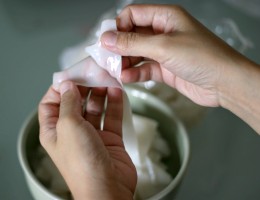
- Separate the noodles by peeling them apart one at a time. Set aside.
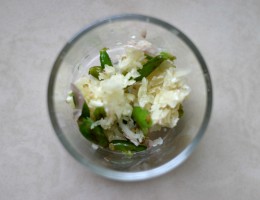
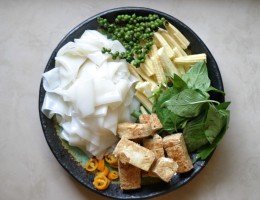
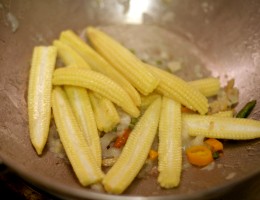
- Prepare your ingredients: Slice the baby corns into 1/2 lengthwise. Crush the garlic and chilies, and set aside. Pick off the leaves & flowers of the basil, and set aside. Chop the large chili into rings.
- If you’re using tofu, pre-fry it in hot oil until browned. Set aside.
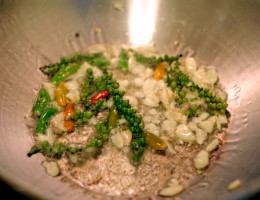
- Add the oil to a pan, and heat on high until it’s dancing around. Then add the garlic, chilies and green peppercorns. Keep stirring so it doesn’t burn.
- When the garlic turns light brown, add the veggies & meat/seafood if adding. Keep stirring and cook until finished, about a minute. You may need to add a few tablespoons of water to help things not stick.
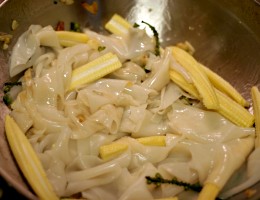
- Add the tofu (if adding), then the noodles. You may need to add a bit more water if the pan gets too dry. Don’t add a lot, or the noodles will get mushy.
- After frying for a minute or two, add the soy sauces, sugar and oyster sauce. Stir well to mix.
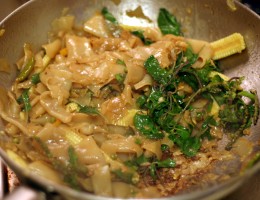
- Add the basil & vinegar. Stir to mix. When the basil is wilted it’s done.
Note:
It's common in Thailand to eat this with spaghetti (yes, from Italy) which has been pre-boiled for a few minutes to just before al-dente. You can leave the noodles out all together (you might need to lower the amount of sauces and spices) and serve with rice.
Tofu can be substituted with bite-sized sliced pieces of seafood (mussels, clams, white-meat fish, shrimp or squid), chicken, pork or beef. Throw it in before you add the vegetables.
You can add chinese cabbage, carrots, white onion or thai rice mushrooms instead or in addition to the baby corn. It's up to you!
If you cannot find fresh peppercorns, substitute with 1/4 - 1/2 teaspoon of white pepper powder. Add it at the end when you add the vinegar.
In the US, when I ordered this dish, it usually came out with a lot of sauce, not quite that spicy, with the wrong basil, no fresh peppercorns

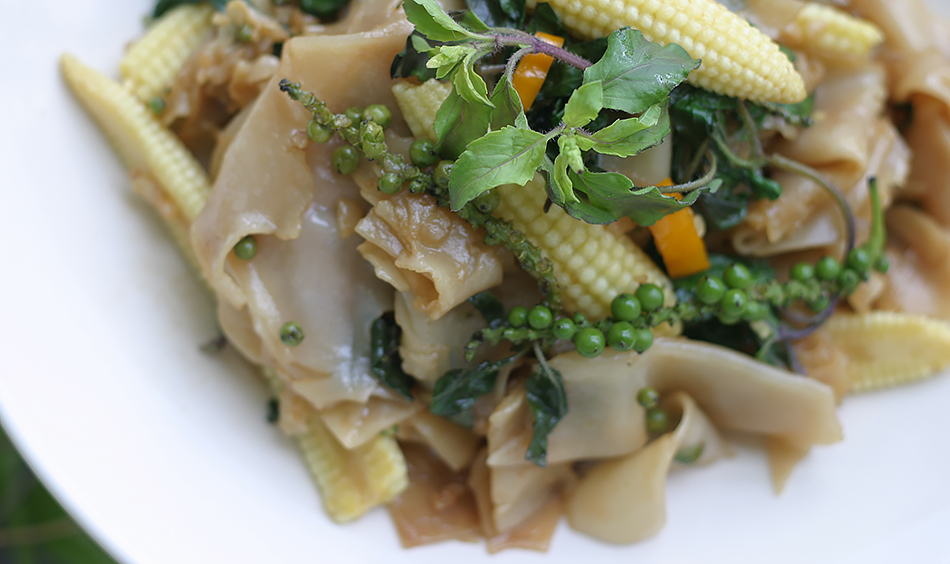
and bell peppers in place of thai chilies. This version here is authentic, using the correct basil (holy basil - 'bai ga-prao') and orange chilies instead of bell peppers. I would totally NOT recommend using bell peppers in this dish. The flavor is really strong and overpowering, and not 'Thai' at all. A lot of cooks outside Thailand substitute spicy chilies (prik chee faa, prik leung, prik kee nuu, etc) with bell peppers. Better to leave them out! You can, however, substitute the orange chili with jalepenos, if that's all you have.
Thais season their noodle dishes at the table with a 'kreung brung' — a small seasoning container which contains a separate cup each of chili powder, vinegar (with pickled chilies), fish sauce (with yet more chilies) and sugar. You then season your noodles to your liking. I added vinegar to this recipe, to make it easier. Normally you wouldn't add vinegar in the wok, you would season at the table.
Ingredients: What You'll Need
- 2 tablespoons vegetable oil
- 1 1/4 cup (1/4 kilo, 1/2 lb) fresh wide rice noodles
- 1/2 cup baby corn (about 6 ears)
- 1/2 cup white tofu, pressed (or 1/2 cup seafood such as squid & shrimp, or meat pieces)
- 2 tablespoons fresh peppercorns
- 2 tablespoons chopped garlic
- 1 tablespoon smashed small thai chilies
- 1 sliced orange chili (about 1 tablespoon)
- 1/2 cup packed holy basil leaves & flowers
- 1 1/2 tablespoons oyster sauce
- 1 teaspoon black soy sauce
- 1 1/2 teaspoons golden mountain soy sauce
- 1 tablespoon white soy sauce or fish sauce (or more to taste)
- 2 teaspoons white sugar
- about 4 tablespoons water
- 1/4 teaspoon vinegar
16 Responses to Drunken Noodles
Loading...

(46 votes, average: 3.7 out of 5)
I thought it was called ‘Pad Kee Mao’ because the ‘Kee-Mao’ cooked it. That’s why he put a lot of chilies. But I think you’re right. It’s good a cure for a hangover ^^
One of my favourite Thai food (even im not a kee mao myself….. eieie)
.Love ur Version as well so Authentic!!!
My waitress at a Thai restaurant told me the origin of the name (from Thai folklore): There was a woman whose husband always came home at night “kee mao” (see discription at top of page), and she would then feed him supper. She always cooked the same thing and he always complained about how bland it was. One night, she decided to give him what he wanted. She threw all kinds of spices in the dish, making it really hot. When her husband ate it, he proclaimed that he loved it! That’s the story.
A Thai-born server at my favorite Thai place says that the name comes from the fact that in Thailand, the dish is eaten when one is inebriated, because the spiciness sobers you up. Sounds like more fun than black coffee.
Great recipe i have made it several times.
I am such a huge fan of Kee-mao at my local Thai restaurant, however, I am very bad with spice. Is this dish extremely spicey, and if so, how could I augment it to make it a bit more managable for myself?
Also, could you add any other kind of vegeatbles you’d like; i.e onions, broccoli, carrots, etc? As that is what is in the Kee-mao I have had.
Thanks for the responses
Austen
Hi Austen,
In the US (and probably elsewhere outside Thailand) Thai cooks substitute hard to find or expensive imported vegetables with common local veggies. Unfortunately, I think many times they don’t really think how these new vegetables play a part taste-wise with the dish. (see my bell pepper rant above!)
I think they think “Foreigners like these vegetables, let’s make Thai food with them, it’s cheaper and more easy for them to recognize”… But if you get a chance, check out what the staff eat. I have a Thai friend here in Bangkok who studied in England. She’d go in to Thai restaurants at staff mealtimes and eat with them because they were actually eating food cooked for Thai taste.
I would say, leave out the broccoli for a try. See if you like it better. Try it with just a bit of meat or seafood, and just baby corns. Carrots are ok, the flavor won’t ruin the dish. If you want to try adding other veggies, see if you can get your hands on Chinese long beans. Those would be OK too.
Also, if you’re bad with spice, no problem. Just add as much chili as you can take. This dish is supposed to be extremely spicy, yes. Just adjust the amount of chilies to your taste.
I had Drunken noodle at my favorite Thai place and it was made with Thai Brandy.
Had it at another place and it was incredible bland with just some spice. I like my Thai with a sauce. I must say even though it may not be authentic to use the brandy, it has become a favorite dish of mine! This recipe looks good and I am eager to try it!
I always thought it was called “drunken noodles” because it is such a spicy dish that you will need quite a few drinks to beat the heat while you eat. Just an alternate take on it, I guess. Anyway, the recipe is awesome. I couldn’t find anything but regular basil, so I can’t wait to try it again with good stuff.
I’m in VA and sometimes it’s hard to find fresh wide rice noodles so I use Linguine or Rotini instead and they always go well with other ingredient. I agree with you that I’ll not add much veggies in this dish, it’s ruin the taste. The must ingredients for me are garlics, basil leaves, chilli peppers, soy sauce, fish sauce and oyster sauce. I sometimes throw dice onion and peper corn in it if I have, but not necessary. I don’t add sugar but I’ll add rice vinegar only if I cook it with rice noodle. I agree not to use bell pepper, but I’ll not recommend to use mexican pepper neither, they smell differently. I’d buy thai peppers or red peppers and freeze them in the fridge so I’ll always have them in hand when I want to use them. Make this menu in authentic taste and make it spicy, everyone will love them!
What’s the serving size for this recipe? I loved this recipe, but I didn’t pay attention to how much fresh noodles I was using and it came out a bit dry. Can’t wait to try it again!
I agree with the bell pepper rant totally. I’ve been searching for a good recipe for this dish on the internet, and most call for bell peppers and don’t call for the fresh peppercorns. Bell peppers don’t have any place in Asian dishes, IMHO. A few Chinese dishes call for them, such as the ubiquitous beef tomato, and you can find them in restaurants in China, but they add a flavor that is much more compatible with Mexican or Italian flavors. I’m heading to the Asian grocery store to get my noodles right now! Unfortunately, since it’s just a small “mom and pop” type store and they cater to Hmong/Laotian customers, I probably won’t find the fresh chow fun so I’ll have to get dried, and I probably won’t find the fresh peppercorns either. Oh well…thanks for the recipe. I grew up in a city where there were many Asian immigrants and restaurants, and now I live in a small Midwestern town, so I’m forced to cook my own noodle dishes to satisfy my cravings. This is a simple recipe, but very authentic.
I am an american kid who grew up in Thailand in the late 60’s and early 70’s. Needless to say, I am hopelessly addicted to thai food. When I was a kid, I don’t remember this dish, but I absolutely love it today. I asked around during my last visit there about the origin and the consesus is that the dish was made by a Thai wife for her husband who would come home after drinking with the boys until late at night. She would scold him to eat his “Drunken Noodles” before he turned in.
I love Pad Kee Mow. Been to Thailand loads but on the last visit we met some cool dudes from Bangkok and they introduced us to this dish - amazing! Luckily we can get all the fresh ingredients here in the UK so I’m making it for lunch today mmmmmmm
I made this last night for dinner and my boyfriend and I both LOVED it! We rate it as restaurant-quality, something I’ve been struggling to achieve with my Thai home cooking. Pad Kee Mao is my favourite thing to order out; now I have lots less reason to buy it when I can make it this good at home! Thanks so much for the recipe, now I’ll have to make lots more for this site.
However, I was a bit unsure about something. How many people is the recipe meant to feed?
my friend like it very much. Thank you for the recipe